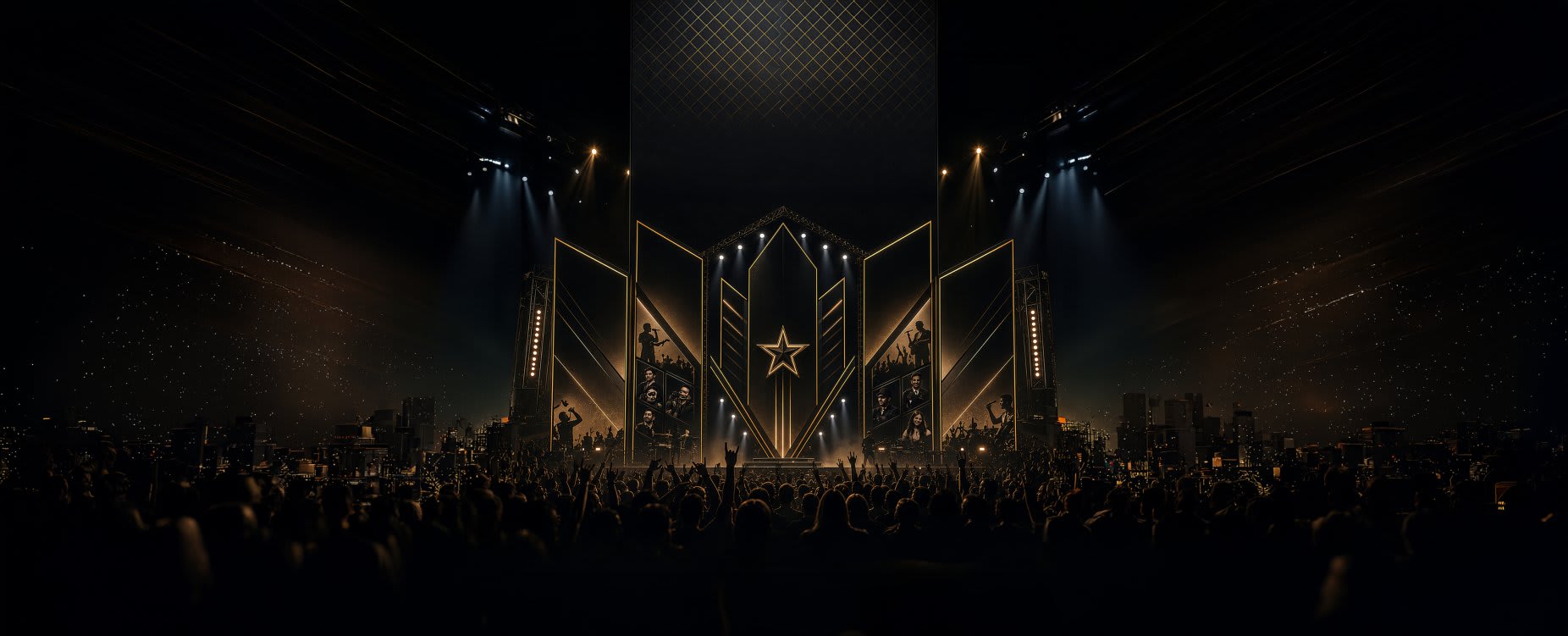
Talentwood by Saregama · Season 5 · Team of 3 to 4
A quiz, then two slides, and India's oldest music label reads every word.
Talentwood is Saregama's campus flagship, now in its fifth season, and it is built around one brutally simple constraint. After the quiz gate, the entire case submission is a maximum of two slides. No appendix, no intro slide, no thank you slide, no file over 5mb. Clear that and you present virtually to a panel. Clear that and you are one of three teams standing in front of Saregama's senior leadership at the Mumbai headquarters, with a pre-placement interview on the line.
Where the season stands
Registrations ran from 6 August to 17 August 2026 and the quiz was held the same evening the window shut. The case study is currently live, with submissions closing 31 August 2026 at 1:00 PM IST. The Grand Finale is scheduled for October 2026 at Saregama's Mumbai HQ. If you are already in, jump to the One Slide Solution section, because that is where Season 5 is decided. If you missed the window, read this as your Season 6 brief. Saregama has kept the round structure remarkably consistent across editions.
What is actually on the table
The cash is real, but the interview is the prize
Winner
₹1,00,000
First Runner Up
₹50,000
Second Runner Up
₹25,000
The prize ladder is clean and it is worth ₹1,75,000 in total across three teams. But the line that should actually move you sits in the fine print under the prize table. Finalists get a chance at a pre-placement interview, and Saregama splits that outcome by year. First year students get a shot at a summer internship. Second year students get a chance at a final placement.
That single clause is why Talentwood is worth eleven days of your time. Most case competitions give second years a certificate and a cheque. This one puts a final placement conversation on the table for them, and a summer internship on the table for first years, from the same contest, in the same room. Very few campus competitions are structured to serve both batches with a real hiring outcome.
👥
Team format
Teams of 3 to 4 members. Teams may be all first year, all second year, or a mix of both. No solo entries.
🚫
The rule that catches people
A participant cannot be a member of more than one team, and team composition cannot be modified after registration. No substitutions later.
🏫
Campus limit
No cap on the number of teams from a single college, and no registration fee. Open to students across India's educational institutes.
💼
The real outcome
Finalists get a shot at a pre-placement interview. First years for a summer internship, second years for a final placement.
🎤
Grand Finale
Top 3 teams present at Saregama's Mumbai office to senior management, 15 minutes each excluding Q&A. Travel arrangements are communicated to finalists.
📧
Communication
The email and phone number used at registration are the only channels used through the competition. Check them daily.
The submission rule that disqualifies good teams
Two slides is a hard ceiling, and the filename is graded too
Saregama specifies a minimum of one and a maximum of two slides, explicitly excluding introductory and thank you slides. The file must stay under 5mb and must be named in the format Case study_Team name_College name_Team Leader First Name. These sound like clerical details. They are not. In a contest where the organiser has publicly drawn a two slide line, a three slide deck signals you cannot follow a brief, which is the first thing any employer screens for. Changes are allowed until the deadline, so submit early and refine later.
The four rounds
Registration, quiz, two slides, and then a room in Mumbai
1
Round 1 · 17 August 2026, 9:00 PM to 10:00 PM IST
Aao Quiz Kare, the 20 minute aptitude and domain gate
A 20 minute MCQ quiz testing aptitude and domain knowledge, held in a one hour window on the evening registrations closed. Rankings are calculated on correctness, and if two teams tie on score, the team that finished faster ranks higher. Only qualifying teams receive the case study.
The tiebreaker is speed, which changes how you play. Do not park on a hard question hoping to crack it. Bank the certain answers fast, then return. A team that finishes in fourteen minutes beats an identical score submitted at nineteen.
2
Round 2 · 18 August to 31 August 2026, 1:00 PM IST
One Slide Solution, the round that actually filters
The case study is released only to qualifying teams. You submit a PPT or PDF summarising your solution in one or two slides, under 5mb, with the specified filename format. Introductory and thank you slides are explicitly barred. You can revise the submission until the deadline closes.
Thirteen days for two slides is not generous, it is deliberate. The time is meant for research and thinking, not design. Spend eleven days on the analysis and two on the layout, not the reverse.
3
Round 3 · Dates to be declared
Virtual Presentation, top 20 teams, 10 minutes each
The top 20 teams present their solutions to a panel over video. Each team gets 10 minutes excluding Q&A. The top 3 teams from this round move to the Grand Finale in Mumbai.
Twenty teams to three is the steepest cut in the competition, an 85 percent elimination. Assume the panel has already read your two slides. Do not narrate them. Use the ten minutes to show the depth behind the slides that the slides had no room for.
4
Grand Finale · October 2026, Saregama Mumbai HQ
Muqaddar ka Sikandar, in front of senior management
The top 3 teams present detailed final solutions to Saregama's senior management, 15 minutes each excluding Q&A. Travel arrangements for finalists are communicated by the organisers. All finalists stand a chance at a pre-placement interview.
Fifteen minutes in front of senior management is a job interview with slides attached. Every finalist is in contention for the PPI regardless of rank, so how you handle Q&A matters as much as where you place.
The number worth staring at
Look at the funnel shape. An open national registration narrows to a quiz ranking, then to a two slide screen, then to 20 teams, then to 3. Every gate before the virtual presentation is asynchronous, which means you are never eliminated by a bad day in a room. You are eliminated by preparation.
That is unusually favourable for a team from a campus without a big case competition culture. There is no campus quota, no institute shortlist, and no cap on entries from one college. The quiz and the two slides do not know where you study.
Understanding the company you are pitching to
Saregama is a 120 year old catalogue trying to behave like a startup
Saregama India is the oldest music label in the country, tracing back to 1901 as The Gramophone Company of India. It owns one of the largest music catalogues in India, spanning decades of Hindi film music and regional repertoire across languages. That catalogue is the asset, and monetising it in a streaming era is the strategic question sitting under almost everything the company does.
The business is no longer just licensing songs. Saregama runs Carvaan, the pre-loaded digital audio player that turned an old catalogue into a hardware product for an older demographic, an unusually clever piece of consumer strategy that MBA students should be able to discuss fluently. It runs Yoodlee Films for content production, has expanded into live events and artist management, and acquired a majority stake in Pocket Aces, the digital content studio behind FilterCopy and Dice Media, pushing it deeper into short form and creator led content.
Talentwood positions itself as students solving real business challenges curated by working professionals who face those challenges daily. Read that literally. The problem statements come from operators, not from a case writing team, so they tend to be specific, current and commercially awkward in the way real problems are. A textbook framework applied cleanly will read as an outsider's answer.
If you want an edge in the room, understand the tension the company lives with. It holds legacy IP with enormous emotional value and a young audience that consumes on platforms Saregama does not own. Any recommendation that connects the catalogue to a new audience, a new format or a new revenue line is speaking directly to the strategy the leadership is already arguing about internally.
Six things that decide this contest
How to make two slides beat a thirty slide deck
1
Put the recommendation on slide one as a full sentence
With a two slide ceiling there is no build up, no context slide, no agenda. Slide one carries the answer stated as a decision Saregama could act on, with the two or three numbers that justify it. Slide two carries the how, the risks and the impact. If the reader stops after slide one, they should already know what you are proposing and why it makes money.
2
Play the quiz for speed, not just accuracy
Saregama breaks ties by completion time. Decide before the clock starts who on the team handles aptitude and who handles domain, agree that nobody argues past 45 seconds on a single question, and treat the last five minutes as review time rather than rescue time.
3
Learn the Carvaan story before you write a word
Carvaan is the single best proof of how Saregama thinks about monetising nostalgia through a completely non-obvious format. A recommendation that references how the company has already turned catalogue depth into a product line signals you researched the business rather than the industry. Panels notice this within thirty seconds.
4
Size it in rupees, with your assumptions visible
Media and entertainment panels think in reach, monetisation per user, licensing yield and content cost. A recommendation carrying even a rough number with stated assumptions outperforms a smarter idea with no number. Put the arithmetic on the slide so the panel challenges an assumption rather than dismissing the conclusion.
5
Keep a research file the slides cannot hold
Two slides force you to discard 90 percent of your work. Do not delete it. The virtual presentation round gives you ten minutes to show exactly that discarded depth, and the Q&A rewards teams who can answer a follow up with a chart they never submitted.
6
Build the team with the finale in mind
Team composition cannot be changed after registration, and a mixed first and second year team is explicitly allowed. A second year brings interview readiness and internship context. A first year brings time. If the finale ends in a pre-placement interview, having both batches in the room means someone is eligible for whichever door opens.
Resources worth an evening of your time
Official links and where to track Season 6
These are the sources worth your time. Click each link to open it in a new tab.
The full round structure, timelines, submission rules, prize breakdown and the Hall of Fame for Seasons 1 to 4. This is the only authoritative source, and where Season 6 will be announced.
Business segments, product lines and the investor section. Read the latest annual report and quarterly disclosures before you build any revenue estimate into your slides.
AceCase Pro and Super100 train MBA students on answer-first structuring, opportunity sizing and panel Q&A, the exact skills a Talentwood submission is scored on.
✓ Mentor reviews on your one slide solution before you submit
✓ Mock panels that replicate a timed presentation with live Q&A
All details in this article are based on the official Talentwood by Saregama Season 5 page and publicly available information as of the publication date. Registrations closed on 17 August 2026 and the case study submission deadline is 31 August 2026. Eligibility, dates, rewards, team size, round structures and pre-placement interview opportunities may change at the discretion of Saregama India Ltd. or the event organizers. Please verify all information on the official Talentwood page before applying to any future edition. AceMBA is not affiliated with, endorsed by, or officially connected to Saregama India Ltd. This guide is for informational and preparatory purposes only.
Discussion
Share your thoughts, case or interview experiences, or strategy insights.
Comments are read by Mentors and all other students. Be respectful, on-topic, and constructive.