There is no case here. There is only you and your idea.
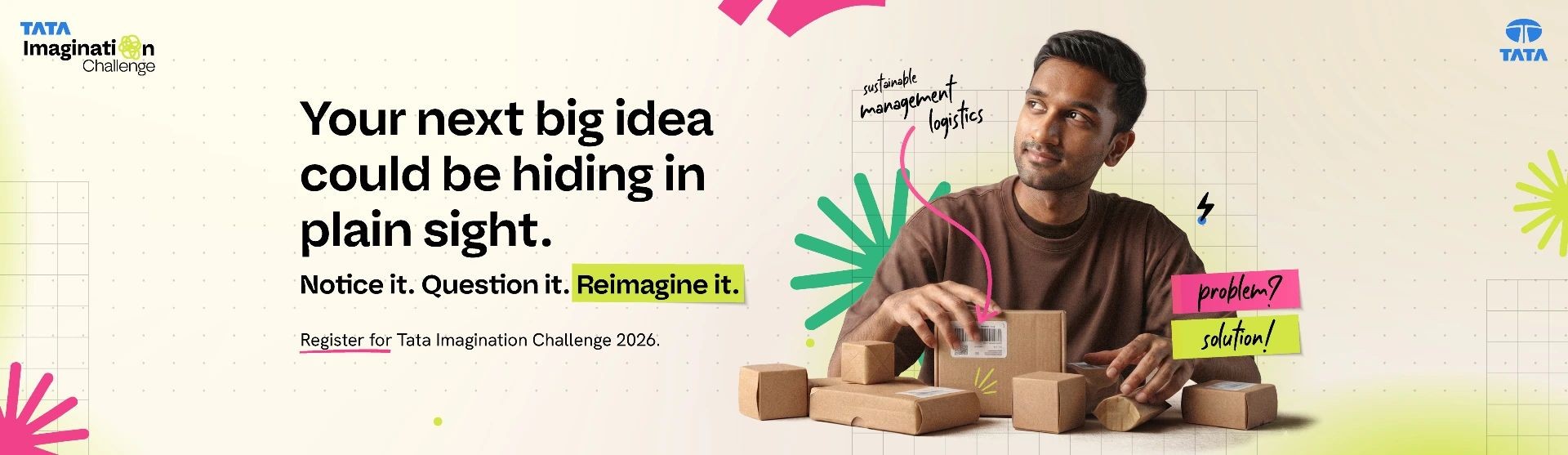
The Tata Imagination Challenge is the one competition on the calendar where preparation genuinely decides the outcome, and where almost nobody prepares. It is not a case contest. Across its rounds it tests general awareness, aptitude, speed, focus, decision making under pressure and finally the quality of your original thinking. The rewards are unusual too: accelerated entry into TAS, ₹2 lakh each for ten winners, an invitation to Bombay House and an all-expenses-paid Tata Trails immersion for the top ten. As of the first week of September 2026, TIC has not launched yet. That is exactly why this is the right week to start.
Why the ROI on TIC is unlike anything else this season
Most competitions offer prize money and a certificate. TIC offers a career door. The single biggest reward is accelerated entry into TAS, the Tata Administrative Services programme, which is one of the most sought-after leadership tracks in Indian industry. Everything else sits on top of that.
How TIC has historically run its three rounds
Over the years the broad journey has looked the same: a quiz, then a gamified assessment, then the idea. Each round filters for a completely different skill, which is why generic case prep does very little for you here. Below is what each round demands and how to build for it.
Train the quiz like an exam, not like trivia
The mistake almost everyone makes with Round 1 is treating it as luck. It is not. The question areas repeat across editions, and once you have solved two or three past sets you start recognising the shape of what gets asked. Business history, Tata group awareness, brands and logos, current affairs, basic aptitude, logical reasoning and a general knowledge spread.
- Tata group history, brands and milestones
- Indian and global business current affairs
- Brand, logo and campaign recall
- Quantitative aptitude and data interpretation
- Logical reasoning and puzzles
- Sports, science and general awareness
The practical instruction is simple. Attempt past questions yourself before reading any solution. Understand the areas from which questions are being asked. Identify where you are weak. Then train for speed, because the clock eliminates more candidates in this round than difficulty does.
The gamified round rewards a calm and fresh mind
Six games, each measuring a different cognitive trait, played against a timer. There is no syllabus and no shortcut. What there is, is a practice round before each game, and that practice round is where most people quietly lose their score.
Use the practice attempt to answer four questions before the real game begins:
One more thing that matters more than technique: do not leave this for the last day. These games need a calm and fresh mind. Attempt them early in the window, in a quiet room, with a stable connection and no pressure of a closing deadline. Fatigue costs more points here than skill gaps do.
A four-step build for the Big Idea round
Do not wait for the competition to launch before you start thinking. Your first objective is to understand how TIC thinks about ideas. Here is the exact sequence we give our students.
Step 1 — Get the ideation basics right
Inside our Basics to Advanced classes, Session No. 15 is the Ideation Challenge session, and it is the foundation for TIC, Reliance TUP, SBI Ideathon and every other open ideation competition. It covers how to generate, structure and evaluate ideas on your own. Do not watch it like a normal lecture. Pause, think, and apply the frameworks to two or three real-world problems as you go. The goal is to build the muscle of generating ideas, not to memorise a framework.
Step 2 — Watch the TIC session with past winners
There is a live session featuring one of our senior mentors along with past TIC winners. Pay special attention to the second half, where the discussion turns to how TIC differs from other ideation and case competitions. The core message: TIC is not simply looking for an idea that sounds commercially attractive. It is looking for the person behind the idea.
Step 3 — Read the official idea guidebook
Go through the official Tata Imagination Challenge Idea Guidebook from last year. Yes, it is generic. Do not dismiss it for that reason. The guide gives you a structured approach to thinking about ideas and, more subtly, tells you what the organisers want participants to think about. Treat it as your starting point. Understand the thinking behind the process instead of copying the process.
Step 4 — Reverse-engineer previous winning ideas
This is probably the highest-value thing you can do before TIC launches. Tata has historically published the Top 40 and the winning ideas. So instead of guessing what a winning TIC idea looks like, go and study what has actually won. Start with the 2021 winners and the 2021 winners slam book, then the 2024 winners announcement, then search out the Top 40 lists from other editions yourself.
Do not read them and move on thinking "nice idea". Interrogate each one:
- What problem were they solving, and how did they identify that problem in the first place?
- What was the underlying insight behind the idea, stated in one sentence?
- Was the idea genuinely novel, or was the execution the novel part?
- Why would this matter specifically to Tata, its businesses or its stated priorities?
- What makes it scalable, and what makes it feasible with real constraints?
- How did it connect to a real consumer or business need rather than a hypothetical one?
- How was the idea presented, and what made it memorable in a pile of thousands?
- What patterns repeat across multiple winners across multiple years?
You are looking for patterns, not copies.
If you study twenty winning ideas and then try to build your twenty-first by stitching together pieces of those twenty, you are doing it wrong. That is the fastest way to produce something that reads as derivative to a judge who has seen all twenty.
The purpose of studying winners is to understand the quality of thinking expected. Your final idea has to come from your own observation, your own insight and your own thought process.
What I want you to do before TIC launches
Not the idea. Not yet. Just the foundation. Here is the checklist:
- Go through the 2024 and 2025 quiz questions and map the areas you are weak in.
- Watch or revise the six gamified round recordings so the interface is familiar.
- Watch Session 15, the Ideation Challenge session, and apply the frameworks as you watch.
- Watch the TIC live session with past winners, especially the second half.
- Read the official TAS Idea Guidebook from last year, end to end.
- Study previous winning and Top 40 ideas, and reverse-engineer at least ten of them.
- Start maintaining an Idea Bank: a running note of interesting problems, observations and opportunities you come across in daily life.
You do not need to arrive at your final TIC idea right now. In fact, you should not. Right now your job is to build the foundation and start noticing things. It takes about three months to win a competition like this, not one overnight sprint.
A much more detailed approach to the Big Idea round is coming next: how to move from problem to insight to idea, how to evaluate your own ideas honestly, and how to build something with a genuine chance of standing out. For now, do the groundwork.
Open every one of these before the launch
- Official Unstop listing for Tata Imagination Challenge 2026
The authoritative source for registration, eligibility, rounds, rewards and deadlines. Bookmark it and check it weekly until the launch.
- Official TIC Idea Guidebook 2025 (PDF)
The organisers' own framing of what a good idea looks like. Generic on the surface, revealing when you read it as a signal of what they want you thinking about.
- TIC 2021 Winners (PDF)
The actual winning ideas from 2021. Read each one and reverse-engineer the problem, the insight and the reason it mattered to Tata.
- TIC 2021 Winners Slam Book (PDF)
The winners in their own words. Useful for understanding the kind of person and thought process TIC selects for, not just the output.
- TIC 2024 Winners announcement on LinkedIn
The most recent public winners list. Look up the winners individually and read what they have written about their submissions.
- AceMBA live session on TIC with past winners
A full session with a senior AceMBA mentor and past winners. The second half explains exactly how TIC differs from a standard ideation contest.
- Perspect AI, last year's gamified assessment partner
Useful context on how gamified cognitive assessments are designed and scored. The partner can change, but the design philosophy rarely does.
Click any link above to open it in a new tab and explore the resource.
We are only 40% through the season
In the last two months alone, more than 50 big corporate case competitions have launched. The season is nowhere near over, and the largest ones are still ahead. Reliance TUP with a ₹6 lakh prize pool and HUL LIME, where national winners take a grand prize of ₹10,00,000 along with a trip to London, are both expected to launch by the end of this month. Both reward the same ideation skill TIC trains. Both are open to students across B-schools, and there are many more in the pipeline.
The pattern in every one of these is the same. The students who convert are the ones who already have the resources, the past papers, the recordings, the winning-idea archives and a mentor who has been through the rounds. Everyone else spends the launch week gathering material that our members already have.
Our early bird offers are now closed. In their place, anyone who enrols in any AceMBA program at full price right now gets second year access at absolutely no additional cost. That is two full seasons of resources, classes, mentorship and competition archives for the price of one.
This is a limited period offer, and it is designed for exactly this moment in the calendar: half the season still to run, TIC about to launch, and the biggest competitions of the year still ahead.
- ✓ Two years of TIC quiz questions with area-wise pattern breakdown
- ✓ Idea Bank reviews and mentor feedback on your Big Idea before you submit