Three minutes of video, and ₹25 lakh on the table.
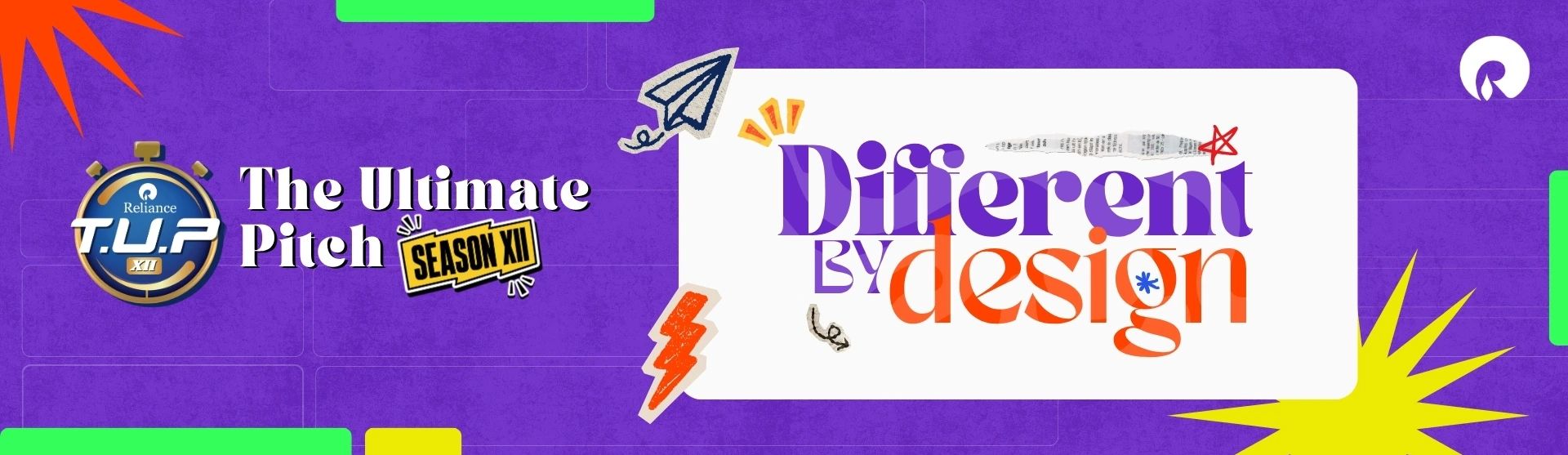
Reliance The Ultimate Pitch is back for Season XII, and unlike most things on the calendar this one is genuinely open: every B-school in India, every stream, every academic year, as long as you are a full-time postgraduate or executive MBA student. There is no case study handed to you. You bring an original idea, film a three-minute pitch, and if it survives, you keep climbing until the Grand Finale at Reliance Corporate Park in Navi Mumbai. This year's theme is Different by Design, and that phrase is doing more work than most people realise.
If you read only one paragraph
T.U.P is an ideation challenge, not a case competition. Nobody gives you a problem statement, which means round one is really a test of whether you have been paying attention to the world for the last few months. Registrations close 20 September and the idea submission window shuts 27 September. Semi-finalists get pre-placement interviews with Reliance, which is the real prize hiding behind the cash.
What is on the table
A ₹25 lakh pool, and a PPI for every semi-finalist
The headline numbers get shared everywhere, but the structure of the prize pool is the interesting part. T.U.P does not concentrate everything on one winner. It pays out deep into the field, which changes the maths of whether it is worth your September.
🏆
The Ultimate Winner: ₹6,00,000
One team walks away with six lakh, the T.U.P title and a place in a lineage that includes some of the most talked-about campus wins of the last decade.
🥈
The Ultimate Runner-Up: ₹3,00,000
Three lakh for second place, plus the same Grand Finale exposure at Reliance Corporate Park that the winners get.
📣
Popular Choice Award: ₹1,00,000
One lakh decided by public voting. Worth planning your video and your campus network around, because this one rewards communication as much as substance.
💸
₹15 lakh across the Elimination Round
20 Elimination Round Winners get ₹50,000 each and 20 Runners-Up get ₹25,000 each, along with T.U.P merchandise. Forty teams get paid before the Semi-Finale even begins.
The reward nobody talks about enough
Pre-placement interviews for every Semi-Finalist
Cash is spendable, a Reliance PPI is compounding. Every team that reaches the Semi-Finale gets a pre-placement interview, and National Finalists get mentored by in-house Reliance experts through the Grand Finale. If you are a first year, this is a shortcut to a summer conversation. If you are a second year, it is a live final placement lever in the middle of the season.
🎓
Eligibility
All B-schools in India, all streams, all academic years, provided you are pursuing a full-time degree. Only full-time postgraduate and executive MBA students can participate.
👥
Team rules
1 to 4 members, one team leader, all from the same institute and the same graduating year. One student cannot be in more than one team. No cap on the number of teams from an institute.
🎯
Theme
Different by Design. The organisers have said it plainly: the future will not be built on clichéd concepts, but on ideas purposefully crafted to stand apart.
⚠️
Hard rule
Plagiarised ideas are disqualified. Recycling a deck from another competition or lifting a startup pitch off the internet is the fastest way to end your season.
Dates you cannot miss
The whole thing runs in seven weeks
1 – 27 Sep
Idea Submission window. Register your team, pick a name, upload a 3-minute pitch video. Every team that submits earns a participation certificate.
20 Sep
Registration deadline. This closes a full week before submissions do, so registering late is not an option even if your idea is not final.
5 – 9 Oct
Elimination Round. Virtual pitch to a live jury: 3-minute video showcase, 3-minute presentation, 4-minute Q&A. Certificate of Appreciation for all participants.
12 – 17 Oct
Presentation and Prototype Submission. Semi-Finale teams refine the deck and build a prototype of the idea.
19 – 20 Oct
Semi-Finale. A 7-minute pitch and 5-minute Q&A on feasibility, market strategy and scalability. Top 10 advance. Certificate of Merit and goodies for all.
Grand Finale
Two days at Reliance Corporate Park, Navi Mumbai. Day 1 is the Reliance Innovation Marketplace with individual booths. Day 2 is the Ultimate Pitch to the Grand Jury.
Read that timeline once more with a placement calendar in your hand. The heavy lifting sits in September, which is exactly when everyone else is busy and exactly why the field thins out on its own.
The connect
This is the same muscle as Tata Imagination Challenge
If you read our Tata Imagination Challenge playbook last week, the entire Big Idea section of that article is your T.U.P preparation. Both competitions are ideation challenges. Neither hands you a problem. Both judge the quality of your thinking as much as the commercial attractiveness of the idea, and both punish ideas that are stitched together from other people's winners.
The differences matter too, and knowing them changes how you prepare:
TIC: individual entry, quiz and gamified filters before the idea
T.U.P: teams of 1 to 4, the idea is the very first filter
TIC: written idea submission carries the weight
T.U.P: a 3-minute video, so delivery is graded from minute one
TIC: reward is accelerated entry into TAS
T.U.P: reward is PPIs plus ₹25 lakh spread across the field
Build one idea bank, enter both
The students who do well in this window are not building two separate ideas. They are running one disciplined idea bank and shaping the strongest entry from it for each format. Read the Tata Imagination Challenge playbook first if you have not, then come back here for the pitch craft.
The angle most teams miss
T.U.P is a pure ideation challenge. There are no quizzes, no gamified assessments, no pre-screening filters before you pitch. The idea itself is the very first filter, which is why the entire Round 3 approach from our Tata Imagination Challenge notes applies here almost line for line.
The rounds are even simpler than TIC, so do not over-engineer your preparation. Your single job is to find a sharp insight and build a differentiated idea that is personal to you. Generic ideas dressed in jargon get cut in the first pass. Ideas that clearly came from something you noticed, tested, or cared about survive.
You can reuse the same research and even the same core idea for both TIC and T.U.P. The formats reward the same muscle. What changes is the brand lens you wrap around it.
1
Tata lens: people, wellbeing, trust, sustainability and giving back
When you pitch for Tata Imagination Challenge, the idea should feel like it improves lives, builds trust, or serves communities. The winning tone is responsible, human, and long-term.
2
Reliance lens: scale, profitability, growth, disruption and commercial viability
When you pitch for T.U.P, the same idea needs to show how it scales fast, makes money, and leverages distribution or technology at Reliance-level magnitude. The winning tone is ambitious, executable, and commercially sharp.
3
The same idea can wear both lenses
A strong idea usually has both angles built in. The skill is knowing which one to lead with. For Tata, lead with the human problem and societal impact. For Reliance, lead with the scale path and business model. Be smart about the frame. That is the secret mantra to winning them.
What past editions teach us
Eleven seasons of patterns worth stealing
T.U.P has been running long enough that its taste in ideas is legible. Season X was won by Team Lucknawis from IIM Lucknow. Season 9.0 went to Team Revengers from IIM Kashipur, whose idea was an AI-based tool for early breast cancer detection, built on a dataset they actually went out and sourced from hospitals in Uttarakhand. Season 8.0 was won by a team from IIM Calcutta with IIM Trichy as Ultimate Runner-Up, and Season 6.0 saw Team Harmony from NMIMS Mumbai finish national runner-up.
Note what the Kashipur team did there. They did not just propose an AI model, they went and got real data. That gap between a claim and a demonstrated claim is most of the distance between a semi-finalist and a winner, and it is also why the prize pool has grown from roughly ₹10.75 lakh in Season 9.0 to ₹25 lakh today. Read the public write-ups and a few patterns repeat with uncomfortable consistency.
1
Winning ideas start from an observed problem, not a trending technology
Almost every published winner can point to a specific thing they noticed: a queue, a wastage, a broken handoff, an underserved customer. The technology arrives later as the answer. Teams that start with "let us do something with AI" get filtered in the elimination round.
2
The idea has to be plausible for Reliance to actually build
This is a Reliance platform. Ideas that ride on scale, distribution, retail, energy, telecom, digital services or the consumer base already in the group's hands land better than ideas that need an entirely new company to exist. You do not have to force a Reliance angle, but you should be able to answer "why would this group be the right owner of this idea".
3
The business case is not optional
The brief asks for practical, scalable ideas with a strong business case. Semi-Finale Q&A goes straight at feasibility, market strategy and scalability. Have your market size, your unit economics and your first-year rollout on a slide you can defend, not on a slide you can read.
4
Prototypes decide the Semi-Finale
A prototype is a formal requirement before the Semi-Finale. It does not need to be code. A clickable mock, a service blueprint, a physical model, a working spreadsheet simulation, all of these have carried teams. What kills teams is arriving with the same deck they had in the elimination round.
5
Popular Choice is won in the first ten seconds of the video
A separate ₹1 lakh sits with public voting. That reward goes to the team whose video is watchable, not the team whose idea is cleverest. Open on the problem in a single sentence, show a face, and never spend your first fifteen seconds on your team name and college.
Round 1, in detail
How to build a 3-minute pitch video that survives
Three minutes is brutally short. Most teams try to fit a full case presentation into it and end up saying nothing memorable. Structure it like this instead and rehearse until you are inside the limit with ten seconds to spare.
0:00 to 0:20 — The problem, stated as something the viewer has personally seen or can instantly picture. No preamble.
0:20 to 0:40 — The insight. One sentence on what everyone else missed about that problem. This is the line the jury remembers.
0:40 to 1:20 — The idea itself, explained so a non-expert understands it on first hearing. Show it, do not describe it.
1:20 to 2:00 — Why it works: the user, the value, and why it is Different by Design rather than an incremental improvement.
2:00 to 2:40 — The business case. Market, model, scale path and the honest constraint you have thought about.
2:40 to 3:00 — Why Reliance, and one closing line that lands. End on the idea, not on a thank-you slide.
The most common reason good ideas get cut
Teams explain what they built and never explain how they got there. The jury is sitting through hundreds of pitches that all sound plausible. What separates the shortlist is whether the team can show the observation that led to the insight that led to the idea.
If your video can be summarised as "here is a product", rewrite it until it can be summarised as "here is something we noticed, and here is what it makes possible".
Members-only resource vault
Pitch video teardowns and idea reviews before you submit
Our members get mentor-led teardowns of what has historically worked in T.U.P style pitch videos, our ideation session on moving from observation to insight to idea, and a review of your own idea and script before the 27 September deadline. Most teams only find out their idea was thin after they are cut. You should find out while you can still change it.
Where the elimination round quietly separates teams
The Elimination Round is a strange format and most teams under-prepare for it. You get a 3-minute video showcase, then a 3-minute live presentation, then 4 minutes of Q&A. That means six minutes of you talking and four minutes of the jury probing. Teams lose here on the Q&A, not on the pitch.
R2
Elimination Round
Prepare the objections, not just the pitch
Before the round, write down the ten hardest questions a sceptical operator would ask your idea. Cost, adoption, regulation, competition, why now, why has nobody done it, what breaks at scale. Assign answers to specific team members. Four minutes of Q&A is enough for the jury to find your weakest assumption if you have not found it first.
Forty teams get paid at this stage. Reaching the top 40 is a realistic target for a well-prepared first attempt, so do not treat this round as a formality on the way to the finale.
R3
Semi-Finale
Seven minutes, a prototype, and the scalability question
The Semi-Finale asks for depth on feasibility, market strategy and scalability. This is where a beautifully told story with no numbers behind it falls apart. Build the prototype early in the 12 to 17 October window rather than the night before, because the act of building it will expose the parts of the idea you have been hand-waving.
Ten teams advance to the Grand Finale at Reliance Corporate Park, where you also get mentored by in-house Reliance experts before the final pitch.
Members-only resource vault
Mock juries and Q&A drills with mentors who have sat on the other side
Our mentors run mock elimination and semi-final panels for members: your pitch, our Q&A, honest feedback on the assumptions you cannot defend, and help sharpening the prototype narrative before the real jury sees it. The teams that convert are almost always the ones who have already been torn apart once in private.
Register your team on Unstop now. Registration closes a week before submissions, and an unregistered team with a brilliant idea is just a brilliant idea.
Lock the team: 1 to 4 people, same institute, same graduating year, one leader. Fix roles early, particularly who owns the numbers.
Run one idea generation sprint. Ten problems you have personally observed, written as problems, not solutions.
Score each against the brief: futuristic, solves a real need, challenges conventional wisdom, practical, scalable, strong business case.
Pick two. Build a one-page argument for each and get an outside opinion before you commit filming time.
Write the script before you touch a camera. Time it. Cut it to 2:50 so you have breathing room.
Sanity-check originality. Anything that reads as lifted gets disqualified, so document how you arrived at the idea.
Submit at least three days early. Upload failures on deadline day are the most avoidable way to lose a season.
The authoritative source for rules, stages, deadlines and rewards. Register here and re-check the dates weekly, because organisers do adjust timelines.
Spend an hour on the business segments and the latest annual report highlights. Knowing where the group already plays is how you answer "why Reliance".
The companion piece. The ideation method, the idea bank discipline and the warning about copying past winners apply directly to T.U.P.
Click any link above to open it and explore the resource.
Where the season stands
September is the heaviest month on the calendar
T.U.P XII is live, the Tata Imagination Challenge is expected imminently, and HUL LIME with its ₹10,00,000 grand prize and a trip to London is expected by the end of this month. Three of the largest open competitions of the year overlap with the same few weeks, and all three reward the same skill: taking something you noticed and turning it into a defensible idea.
The teams that convert in this window are never the ones starting from zero on the day of the announcement. They already have an idea bank, a mentor who has sat on the other side of a jury table, and someone honest enough to tell them their idea is thin while there is still time to fix it.
Limited period · Early bird has ended
Enrol at full price now and get your second year access free
Our early bird offers are closed. In their place, anyone who enrols in any AceMBA program at full price right now gets second year access at no additional cost. Two full seasons of classes, mentorship, competition archives and pitch reviews for the price of one.
The timing is deliberate. T.U.P closes on 27 September, and the rest of the season's biggest competitions are still ahead of you.
AceMBA · AceCase Pro and Super100
Pitch craft, idea reviews and mock juries
Ideation sessions, teardowns of what wins in video-first pitch rounds, prototype guidance for the Semi-Finale, and mentors who review your idea before you submit rather than after you are cut.
✓ One-to-one review of your T.U.P idea and 3-minute script before the deadline
✓ Mock jury panels with Q&A drills modelled on the elimination and semi-final formats
AceMBA is an independent mentorship platform and is not affiliated with, endorsed by, or officially connected to Reliance Industries Limited, T.U.P, Unstop, the Tata group, or any other entity mentioned in this article. All competition details, including eligibility, team rules, round formats, rewards, prize amounts and dates, are compiled from the official public listing and past editions as of the date of publication, and are subject to change by the organisers without notice. References to past seasons and past winners are drawn from publicly published accounts and are indicative only. The official Unstop listing and Reliance communications are the authoritative sources for rules and deadlines, so please verify all details there before registering. This article is for educational and informational purposes only.
Discussion
Share your thoughts, case or interview experiences, or strategy insights.
Comments are read by Mentors and all other students. Be respectful, on-topic, and constructive.