The student who won
a national competition
before college began.
I want to tell you about one of my students. Not to impress you, but to show you exactly what's possible when you understand something most MBA students don't figure out until it's already too late.
His name is Khushal Agarwal. IIM Bangalore, Class of 2027. CAT 2024, 100 percentiler. By every measure, a brilliant student. But what happened in May 2025, before his first semester even started, is what I want you to pay attention to.
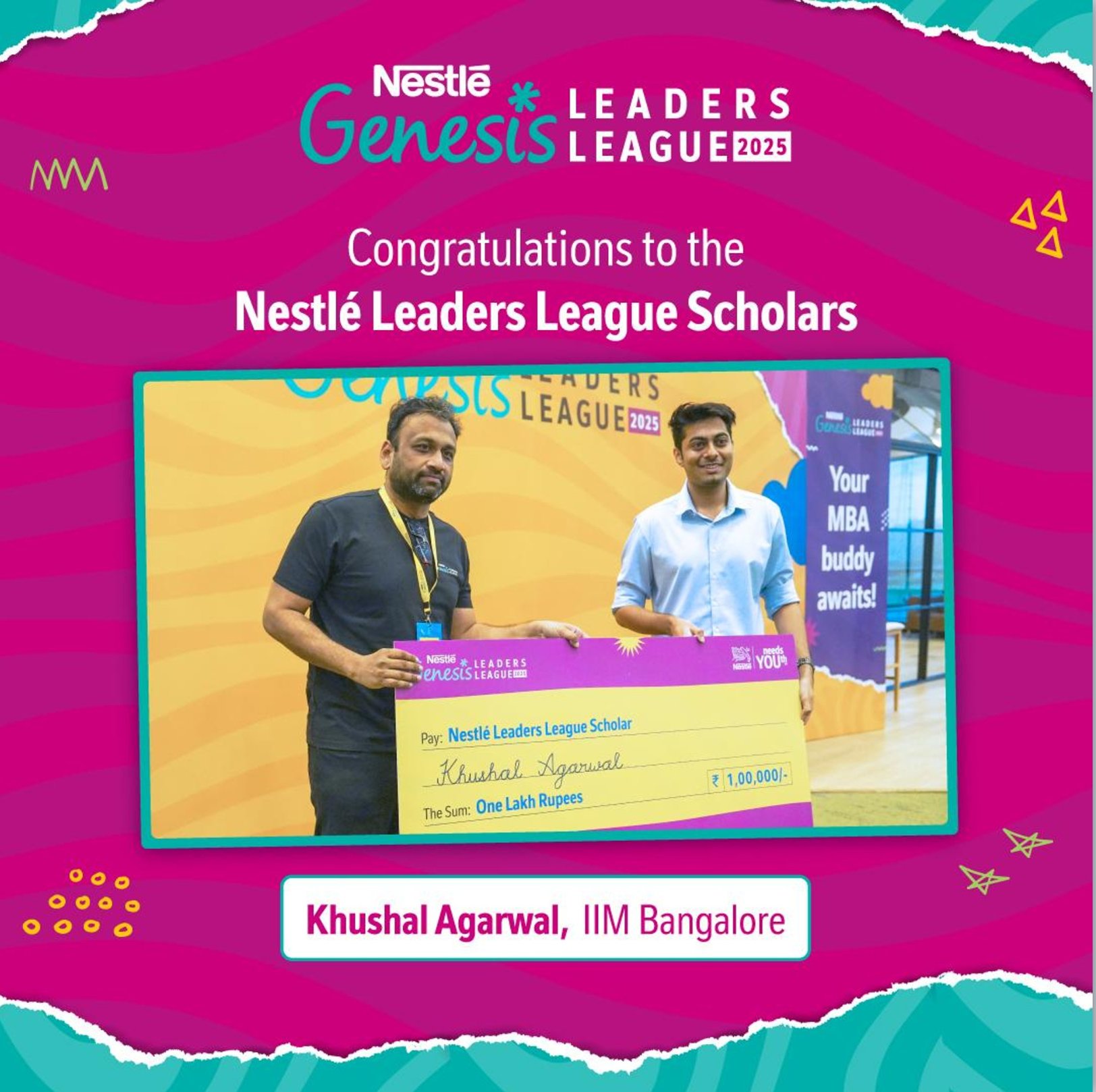
Khushal entered Nestlé Genesis Leaders League 2025, one of India's most prestigious MBA case competitions, run by Nestlé directly. Genesis is invite-only for incoming students from the top league of B-schools, the IIMs, FMS, SPJIMR, XLRI and a select few others, with Pre-Placement Interviews and senior mentorships on the line. Over 8,000+ students participated. And Khushal, a student who hadn't sat in a single business class yet, finished in the Top 5 nationally. He walked away as a Nestlé Leaders League Scholar, receiving a prize cheque of ₹1,00,000.
Now here's what I need you to understand. Khushal didn't win because he's a 100 percentiler. Being brilliant gets you into IIM Bangalore, it doesn't automatically teach you how to structure a business problem, build a compelling slide, and pitch to industry judges under pressure. That's a different skill entirely.
What made the difference was that he started preparing early. And here's the thing, even though he was a CAT 100 percentiler joining IIM Bangalore, the holy trinity of MBA in India, he didn't walk in with a chip on his shoulder. He knew the moment he stepped onto campus, he'd be competing with the brightest minds in the country, students just as sharp, just as ambitious, just as hungry. So he chose to get a head start. He joined AceMBA's Super100 cohort, our flagship program, and spent the weeks before college learning how case competitions work, how winning solutions are built, and how to think the way judges want to see. His determination and hard work did the rest. But the direction was right from day one.
"8,000 students competed in Nestlé Genesis 2025. Khushal hadn't attended a single business class yet, and still finished in the Top 5 nationally."
I'm sharing this because I want you to see the opportunity in front of you, not after you reach campus, not after your first semester, but right now. Today. The window is real, and it's open.
What exactly is a
case competition?
Think of it this way. Every year, some of India's biggest companies, Nestlé, Flipkart, Amazon, HUL, ITC, Reckitt, TVS, Meesho, walk into the MBA ecosystem and say: "We have a real business problem. We want the sharpest students in India to solve it."
They release a problem statement. Teams of 2 to 4 MBA students get it, research it, build a recommendation, design a presentation deck, and pitch their solution to a panel of industry judges, sometimes in rounds, sometimes all the way to a national final. The best teams win prizes, cash, scholarships, and often something far more valuable, direct access to the company and their recruiters.
These aren't hypothetical classroom exercises. The problems are real, the companies are real, the judges are real, and the stakes are real.
Why companies run these,
the recruiter's lens
Most students think case competitions exist to reward smart students. That's partly true. But the more important truth, one that completely changes how you should think about them, is this: for recruiters, case competitions are a premium hiring channel.
Think about it from their side. A typical campus placement process is a lottery. Hundreds of CVs. A few rounds of interviews. Limited signal on how a candidate actually thinks under pressure, solves ambiguous problems, or communicates a business recommendation to a senior audience.
Case competitions solve all of that in one shot. Recruiters get to watch you work. They see your frameworks, your logic, your deck quality, your stage presence. The best candidates self-select by performing, not by credentials alone. Which is exactly why companies invest heavily in running these competitions every year, and why PPIs from case competitions are treated differently from standard placement interviews.
When a recruiter watches a case competition final, they're not looking for the "right" answer. They're looking for structured thinking, business judgment, the ability to synthesise complexity into a clear recommendation, and confidence under pressure. These are exactly the skills you need in your first corporate role, and case competitions are the most direct way to demonstrate them.
This is also why a national finalist tag or a competition win carries disproportionate weight in your placement interviews. You've essentially already passed a screening that the company ran themselves. The recruiter already knows you can think. The conversation shifts from "can you do this?" to "how quickly can you start?"
What you actually gain
from competing
Let me be honest, the prize money is nice, but it's not why you should care about case competitions. Here's what you actually walk away with, especially if you start early.
- You learn how business problems are actually structuredFrameworks like MECE, Porter's Five Forces, TAM-SAM-SOM, GTM strategy, you'll hear these in class, but you'll only truly understand them when you apply them to a live problem with a deadline. Case competitions force real application, and that sticks differently than any lecture.
- You build a portfolio of proof before placements even beginEvery competition you attempt, win or lose, is something concrete to talk about. "I reached the national finals of Flipkart Wired" or "our team was a Top 10 finalist at GE Healthcare ThinkAloud" is a story a recruiter remembers. It's lived experience that separates you from equally-qualified peers.
- You develop deck-making and presentation skills that transfer everywhereA sharply designed, insight-led slide deck is a career skill, not just a competition skill. The students who compete regularly become dramatically better at structuring arguments visually, which pays dividends in every corporate role, every team presentation, every board update.
- You gain access to recruiters in a context that money cannot buyCompeting gets you in rooms, virtual and physical, with senior company leaders who are evaluating you not on your CV, but on your thinking in real-time. That kind of access doesn't happen in the standard placement process. And if you perform, it converts: PPIs, referrals, and direct outreach from the company are all real outcomes that AceMBA students have experienced.
- You build confidence, and that compounds the mostThe first time you submit a case solution is uncomfortable. The second time is less so. By your fifth competition, you walk in with a clarity and calm that students who've never competed simply don't have. That confidence shows up in interviews, in group discussions, in the way you carry yourself in your first 90 days at work.
The season starts
earlier than you think
Here's something the MBA brochures don't put on the front page. The case competition calendar in India is brutal in its timing for first-years.
These timelines are indicative. Every college, year, and batch can shift them by a couple of weeks, but historically, this is the pattern season after season.
The students who wait until August to "figure out" case competitions are already behind. Not because they're less capable, but because building case-solving intuition takes reps, and reps take time. The students who start in May have a 3-month head start that's almost impossible to close by November.
Introducing AceCase Pro,
India's most comprehensive
case competition program
I built AceCase because I saw the same pattern repeat every year. Brilliant students. Right intentions. Wrong approach. They'd try to self-study, watch random YouTube videos, and then wonder why their submissions weren't shortlisting. The problem was never ability. It was structure.
AceCase Pro is end-to-end case competition preparation, from absolute zero to national-finals ready. Built on the actual frameworks and approaches that national winners use. Not theory. Not generic coaching. The real playbook. And it's part of the Super100 flagship program, the same program Khushal joined before his MBA began. So the story you just read connects directly to what comes next.
Land Dream Jobs.
- ✦ 15+ sessions from basics to advanced, 30+ hours of structured guidance across frameworks, market research, financials, presentations, and mindset
- ✦ 20+ real case breakdown practices, Flipkart Wired, Reliance TUP, Asian Paints, TVS Credit, TCPL, Bajaj Finserv, and more from actual national competitions
- ✦ Personalized deck reviews, sharp, one-to-one feedback on your actual submissions for clarity, design, and impact
- ✦ Winning case toolkit, 30+ resources including framework cheat sheets, winning PPTs, finance for case comps, AI prompts, and a competition calendar
- ✦ National winner walkthroughs, live and recorded sessions from students who've won at Nestlé, Amazon, ITC, J&J, Reckitt, Flipkart, and more
- ✦ 20+ mentors from India's top b-schools, IIM Lucknow, IIM Bangalore, SPJIMR, MDI, IIM Ranchi and beyond
AceCase Pro, as part of Super100, is for students who don't want to figure it out by trial and error while the competition window is closing. It's the structured shortcut that doesn't cut corners, built by someone who has stood where you're standing and learned what actually works.
The window is open.
Right now.
Khushal's story isn't an outlier. It's a template. Over the last few years, I've seen versions of it play out with student after student, different colleges, different competitions, different companies, same underlying truth. The ones who start early and start right build something that can't be manufactured later under deadline pressure.
You just got your admit. You have weeks, maybe months, before college begins. That is a gift that most of your future batchmates are not using. You're reading this, which means you already see something they don't.
The next step is simple. Start with the free Practice Case Challenges in the AceMBA community. Get your first rep in. Feel what it's like to solve a real problem under a deadline. Watch how a national winner approaches it differently. And if you want the full program, the structure, the mentorship, the toolkit, Super100 with AceCase Pro is there when you're ready.
The competition season starts sooner than you think. But so does your preparation, if you choose to begin.