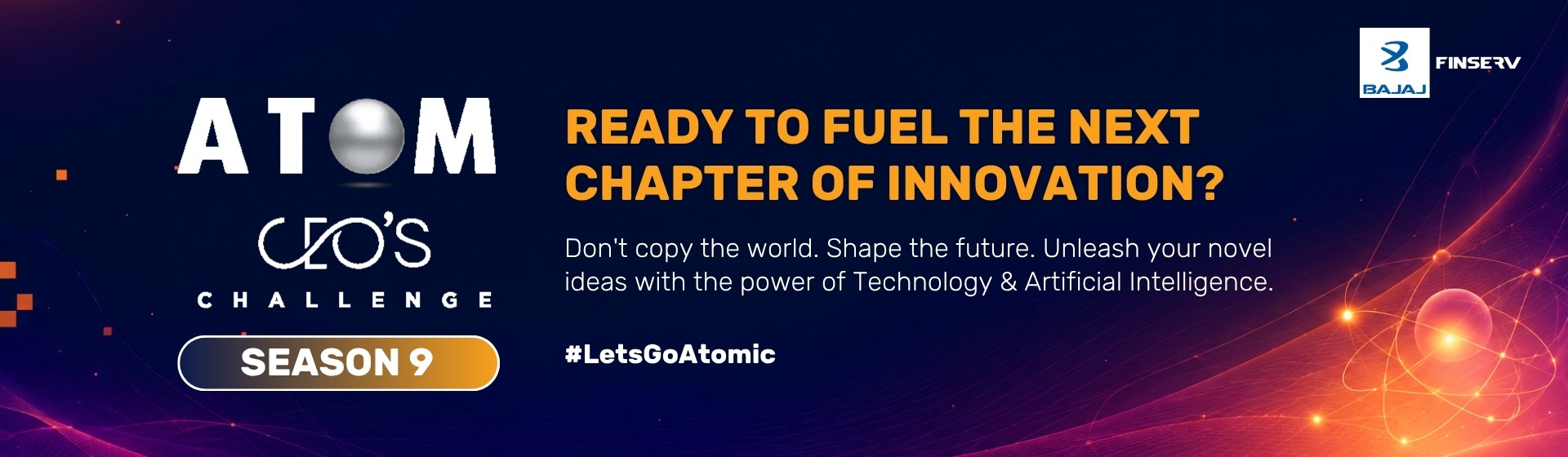
Bajaj Finserv ATOM · Season 9 · 1st & 2nd Year Tracks
Not a case study. A funding round for the idea you have not had yet.
Last year's national winner was an AceMBA student, and the thing they said afterwards stuck with us: ATOM does not reward the team with the cleanest analysis, it rewards the team with the most defensible view of 2030. This is an un-case competition built on scenario planning and design thinking, judged by Bajaj Finserv's own CEOs, with a ₹5,00,000 grand prize and a PPI into the group's flagship leadership programs sitting behind it. Here is how the whole thing actually works, and where teams lose it.
The short version
What ATOM actually is, and why it reads differently
Most competitions hand you a problem statement with a defined boundary and ask for the best answer inside it. ATOM does the opposite. The brief is a future, not a problem. You are asked to look at where financial services are heading in an open banking era, pick a direction you believe in, and design a solution for the customer who will exist then rather than the one who exists now. Scenario planning and design thinking are named explicitly in the format, which tells you what the judging panel is calibrated for.
The competition is structured like a startup raise, and the language on the platform makes that literal. You pitch an idea, you go through a Series A funding round, then a Series B, and the strongest ventures reach a Grand Finale in front of Bajaj Finserv leadership. Teams that clear Series A are already in the money, which is a structural detail worth internalising when you decide how much time to invest.
🎓
Who can enter
Full-time 2-year MBA students, 1st and 2nd year, from a closed list of eligible campuses. One-year programs are excluded. Separate tracks run for each year.
📧
Registration rules
You must register with your institute email id only. Cross-college teams are not allowed.
✈️
The in-person clause
Every team member must be present in person for Series B and the Grand Finale. Students on exchange programs during that window cannot participate. Read this before you build a team.
🏆
The prize pool
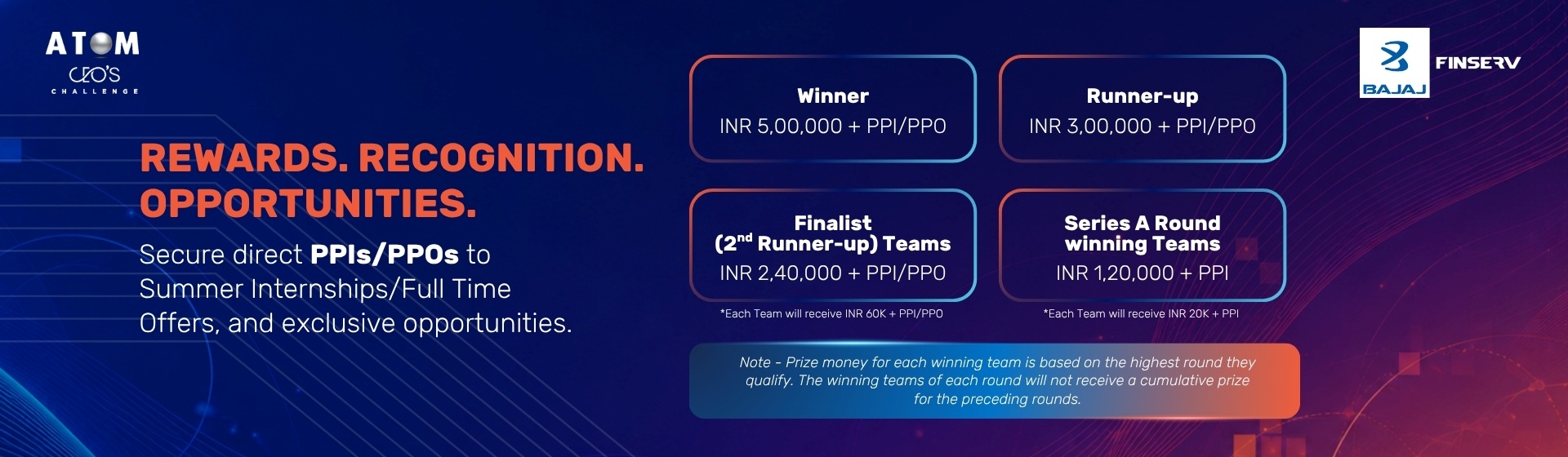
₹5,00,000 for the winners, ₹3,00,000 for the runners-up, ₹60,000 each for the second runners-up, and ₹20,000 each for every Series A winning team.
🚀
The real prize
PPI or PPO alongside the cash. First years get a PPI for the Group Young Leaders Internship Program (GYLIP), second years for the Group Young Leaders Program (GYLP).
🎥
Unusual advantage
Bajaj leaders publish video briefings on each problem statement before you submit. Almost no other competition gives you the judge's framing this early.
🏁 Bajaj Finserv ATOM CEO's Challenge Season 9 · Hosted on Grad Partners
Two separate tracks, one leadership program at the end
The 1st Year and 2nd Year tracks run as distinct opportunities with their own registration links and their own shortlists. Season 9 drew over 9,000 registrations across both tracks, so check the listing for the current window, the problem statement set and the round calendar before you plan anything.
Registrations for Season 9 had closed at the time of writing
Both the 1st Year and 2nd Year tracks were showing as closed when we published this. ATOM runs annually and the format has been remarkably stable across seasons, so treat this as your preparation head start for the next edition. Follow the official Bajaj Finserv LinkedIn, Instagram and WhatsApp channel, and keep an eye on your placement committee mailers, since campus nominations sometimes move faster than the public listing.
The six briefs on the CEO's agenda
You are not solving a case. You are picking a business to bet on.
Season 9 published six problem statements, one from each major Bajaj Finserv business, each introduced by a leader from that company in a short video. That structure matters more than it looks. Your first strategic decision is not how to solve a problem, it is which business you understand well enough to say something non-obvious about.
PS1
Bajaj Finance Limited
The lending engine: consumer, SME, commercial and rural credit, deposits, and the partnerships layer around them.
PS2
Bajaj Life Insurance
Protection and long-horizon savings, where the product is a promise and the hard problem is persistency and trust.
PS3
Bajaj General Insurance
Motor, health and property cover, where claims experience and distribution economics decide who wins.
PS4
Bajaj Finserv Health
The intersection of insurance and care delivery, the most greenfield of the six and the friendliest to genuinely new ideas.
PS5
Bajaj Finserv Asset Management
A young AMC in a crowded market, where the interesting questions are about behaviour and acquisition, not fund construction.
PS6
Bajaj Finserv Direct
The digital marketplace and platform play, which is where open banking and data portability show up most directly.
Watch the videos before you shortlist
Each problem statement comes with a short video from a Bajaj leader, running between about a minute and a half and three and a half minutes. Watch all six even though you will submit against one. The vocabulary the leader uses is the vocabulary the evaluators will grade against, and the constraint they mention casually in passing is usually the one that kills half the submissions. Transcribe the two or three sentences where they describe what a good answer looks like, then put those words in your deck.
Eligible campuses
A closed list, which is good news for your odds
Open to full-time 2-year MBA students from these institutes
FMS Delhi
IIFT Delhi & Kolkata
IIM Ahmedabad
IIM Bangalore
IIM Calcutta
IIM Indore
IIM Kozhikode
IIM Lucknow
IIM Mumbai
ISB Hyderabad
JBIMS Mumbai
IMT Ghaziabad
NMIMS Mumbai
SPJIMR Mumbai
SIBM Pune
TAPMI Manipal
XLRI Jamshedpur & Delhi
Some campuses carry program-level conditions: ISB is open to the 2-year PGPYL program only, IMT Ghaziabad to PGDM Core and PGDM BFS students, and XLRI to BM students. One-year programs are excluded across the board. Verify your own eligibility on the listing before you spend a week on a deck.
The funnel, stage by stage
Idea, Series A, Series B, Finale
R1
Stage one
The idea submission
Register with your institute email, form your same-campus team, pick one of the six problem statements and submit your big idea, usually as a short deck or written concept. The bar here is not polish, it is distinctiveness. Evaluators are reading hundreds of submissions in which the same four ideas appear repeatedly: an AI advisor, a super app, a gamified savings product, an embedded insurance play. If your one-line idea could be pasted under any of the six problem statements without changing, it is not specific enough to survive.
💡 Write your idea as a 2030 headline first. If the headline is not surprising, the idea is not either. Then work backwards to why it is possible only in an open banking world.
R2
Stage two, and already in the money
Series A funding round
Shortlisted teams present their concept in a funding-round format. Winning teams at this stage take home ₹20,000 each and a PPI, which makes Series A the highest return-per-hour checkpoint of the entire competition. Expect the evaluation to shift from the idea itself to whether you can defend it: market size logic, why now, what breaks it, and what you would build first.
💡 Prepare a one-slide risk register you volunteer before you are asked. Naming the two ways your idea fails, and how you would test for them cheaply, reads as founder maturity rather than weakness.
R3
Stage three, in person
Series B, with leadership mentoring
Series B requires all team members to attend in person. This is the stage where Bajaj Finserv leaders engage directly with your concept to make it implementable, scalable and sustainable, the three words the organisers use themselves. Teams that treat mentoring as validation of what they already built tend to plateau here. Teams that visibly change their solution in response to a leader's input tend to advance.
💡 Bring an explicit list of the three decisions you are still unsure about. Handing a mentor a real question is the fastest way to get a genuinely useful answer instead of polite encouragement.
R4
The finale
Grand Finale in front of the CEOs
The final pitch is made to Bajaj Finserv leadership, in person. The winners take ₹5,00,000, the runners-up ₹3,00,000, and the second runners-up ₹60,000 each, with PPO or PPI attached at every level. At this stage the panel is not comparing analyses, it is comparing bets. The question in the room is whether they would actually fund this, staff it, and defend it in their own review meeting.
💡 Close with what you would do in the first ninety days with a real budget and a real team. Concreteness at the end is what separates a good student pitch from something a CEO can act on.
The Season 9 reward structure, as published by the organisers.
The reward stack
Cash at four levels, and a leadership program behind all of them
🥇 Grand Finale winners
₹5,00,000
Cash prize plus PPO or PPI into the Bajaj Finserv group leadership program.
🥈 Runners-up
₹3,00,000
Cash prize plus PPO or PPI for the full team.
🥉 Second runners-up
₹60,000 each
Finalist team members receive the cash prize each, plus PPO or PPI.
💰 Series A winners
₹20,000 each
Every winning team at the Series A funding round is rewarded, with a PPI attached.
Read the fine print on the PPI once, carefully. First year students receive a PPI for the Group Young Leaders Internship Program, and second year students receive a PPI for the Group Young Leaders Program. These are the group's structured leadership tracks, not a generic interview slot, which is what makes ATOM one of the highest ROI competitions on the calendar if you are targeting strategy, financial services or a leadership program role.
How to actually win it
Seven things we would tell our own members before they submit
1
Build a scenario, not a forecast
A forecast says the market will grow at a rate. A scenario says here are two uncertainties that matter most, here are the four worlds they create, here is the world we are betting on and why. That structure is the actual method ATOM names in its format, and almost nobody uses it properly. Pick two genuine uncertainties, for example the pace of data portability adoption and whether distribution consolidates or fragments, and design for one quadrant deliberately.
2
Anchor on the open banking premise, because they did
The brief specifically frames the future of financial products in an open banking era. In the Indian context that means account aggregators, consent-based data sharing, UPI rails and embedded finance. If your solution would work equally well in 2016, it is not answering the question asked. Make the mechanism that only works with shared consented data the centre of the idea, not a footnote.
3
Design for the customer of 2030, with a named persona
The organisers talk about citizens of tomorrow and changing buying behaviour. Give the panel one specific person: a first-time-formal-credit gig worker in a tier-two city, a dual-income couple insuring elderly parents remotely, a small merchant whose entire cash flow is digital. A named persona with a real friction point beats a total addressable market slide in every pitch we have watched.
4
Show the unit economics, even roughly
This is a funding round in framing, and it is judged by people who run profit and loss statements. Cost of acquisition, expected loss rate or claims ratio, contribution per customer, payback period. Rough numbers with stated assumptions beat no numbers by a wide margin, and they beat precise numbers with hidden assumptions by an even wider one.
5
Use the fact that it is a group, not one company
Bajaj Finserv spans lending, life insurance, general insurance, health, asset management and a digital marketplace. Ideas that create value across two of those businesses, for example a health data signal that improves both underwriting and lending decisions, are unusually attractive to a group CEO panel because they are the ideas only this group can execute. Just be honest about the internal complexity that creates.
6
Build the team for the in-person stages
Series B and the Grand Finale require every member physically present, and cross-college teams are barred. Pick teammates who can actually travel, whose exam and exchange calendars are clear, and who can present. A brilliant strategist who cannot make the finale is a liability the rules will not forgive.
7
Treat every round as an interview, because it is
PPIs and PPOs attach at multiple levels here, which means the people evaluating you are also assessing you as a future colleague. How you respond to a hard question, how you credit a teammate, whether you concede a fair point cleanly. Past finalists consistently report that the conversation after the pitch mattered as much as the pitch.
Segment structure, the six businesses and the strategic language leadership uses publicly. Skim the latest investor deck before you write a single slide.
Click either link to open it in a new tab and explore the resource.
AceMBA · AceCase Pro and Super100
Scenario planning is a skill, and it is teachable
Ideation-led competitions punish generic thinking harder than any case study does. Our members work on the specific muscles that pitch rounds test.
✓ Expert-led sessions on scenario planning, design thinking and pitch structure
✓ Feedback on your idea before you submit it, from mentors who have judged rounds
✓ Members-only breakdowns of what winning submissions actually looked like
✓ A community of finalists across the national circuit to build teams and pressure-test ideas
AceMBA is an independent mentorship platform and is not affiliated with, endorsed by, or officially connected to Bajaj Finserv, Grad Partners, or any other entity mentioned in this article. All competition details, including eligibility, the institute list, rounds, rewards and timelines, are compiled from the public Grad Partners listing for ATOM CEO's Challenge Season 9 as of the date of publication, and are subject to change by the organisers without notice. Descriptions of round formats and evaluation priorities include our own interpretation based on the published format and reports from past editions, and are not official statements by the organisers. External links are provided for reference only and AceMBA does not control or endorse their content. Banner images are the property of their respective owners and are used here for identification and reference only. The official listing is the sole authoritative source of competition rules. Please verify all details there before registering. This article is for educational and informational purposes only.
Discussion
Share your thoughts, case or interview experiences, or strategy insights.
Comments are read by Mentors and all other students. Be respectful, on-topic, and constructive.