Amazon ACE Challenge 2026 · 16th Edition · Teams of Four
Round one is not a team round. It is four separate exams that get averaged into one score.
The Amazon Customer Excellence Challenge is back for its sixteenth edition, and almost every team that goes out does so in the first thirty minutes. The preliminary round is an individual caselet quiz taken by all four members, pitched at CAT level difficulty, and the team advances on the average. There is no carrying a weak member through it, no dividing the work, no one person rescuing the score. What follows is not a deck. Amazon is one of the few companies that asks for a Word document in its own template, a campus presentation in front of Amazon leaders and alumni, and a national finale in Bangalore. Prizes worth over two lakh rupees, Alexa devices, gift vouchers, a day at Amazon, and pre placement interviews for the people who stand out.
Why this one lands differently
Yesterday's success stories in this community came from students sitting exactly where you are now. ACE is one of the few competitions where the winning team gets a day inside Amazon and the strong performers get a PPI conversation, and it is open to a select list of campuses only. If your institute is on that list, this is one of the highest value entries of your season.
What is on the table
Two lakh plus in rewards, and the part nobody puts on a poster
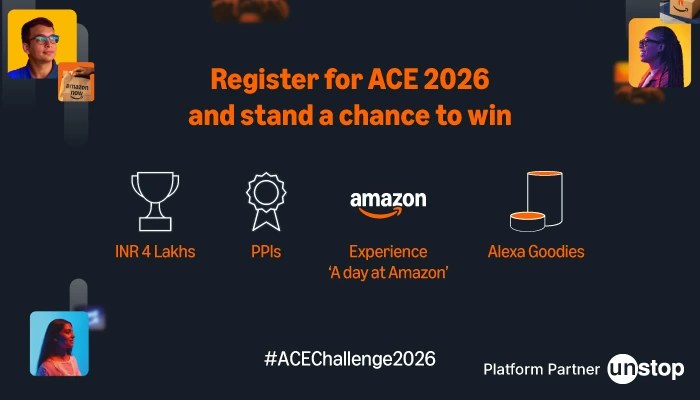
The headline package is prizes worth over two lakh rupees, and it comes in a mix that is unusual for a corporate competition. Amazon Alexa devices and products, Amazon gift vouchers, the chance to experience a day at Amazon, and pre placement interview opportunities for select candidates. Past editions have carried a broader reward pool across the podium, with cash awards for the winners and both runners up, Amazon goodies, certificates and mentorship attached to the top three positions.
The PPI is the line that matters. Amazon runs one of the most competitive campus hiring processes in India, and ACE is a route into a conversation that thousands of applicants never get. Everything else on the list is a nice week. The interview is a career door.
👥
Team size
Teams of 4 members. All four take the preliminary assessment individually.
🎓
Who can enter
Postgraduate management students from the eligible campus list, roughly the top forty B schools. Register with your official college email ID. First years without an official ID can use a Gmail ID validated by the placement committee.
⏱️
Round one
A 30 minute assessment with three caselets per member. Team score is the average of the four. Top teams and wildcard individuals advance.
🏆
The outcome
Prizes worth ₹2,00,000 and above, Alexa devices, gift vouchers, a day at Amazon, certificates and PPI opportunities for select candidates.
The button above opens the official Unstop page in a new tab, where registration, the eligible campus list and the live dates sit.
The journey, stage by stage
Five stages, and only one of them is a team effort at the start
1
The filter
Preliminary Round, a quiz that hits CAT level difficulty
Each team member sits a thirty minute assessment built around three caselets, and this is effectively a quiz round rather than a case round. Participants across editions describe the difficulty as sitting at CAT level, closer to a hard data interpretation and logical reasoning set than to a business discussion. Expect dense caselets with tables, percentages, multi step calculations and answer options designed to catch the shortcut you were about to take. Team scores are the average of the four members, and top teams advance along with wildcard individuals who scored well even though their team did not clear.
Thirty minutes for three caselets is about ten minutes each including reading. Prepare it like a CAT DI LR sectional, not like a case comp. Timed sets, one caselet parked the moment it stops giving returns, and no calculator dependence.
2
The written cut
Campus Round, a Word document in Amazon's own template
Shortlisted teams submit their phase one solution as a Word document in the template Amazon provides, four pages total, split as a two page solution and a two page appendix. Amazon is one of the very few companies that will not accept a deck. There are no slides, no design marks, no animation to hide behind. It runs on narrative documents internally and the submission format is a direct reflection of that, which also means the template is not a suggestion. Teams get cut for going over the page count or reformatting the file.
Big tip from past editions: Amazon rewards teams that go data heavy and lay it out in clean tables. A tight comparison table with numbers, assumptions and a source column carries more weight here than any amount of prose. Push every table, calculation and exhibit into the appendix, keep the two page solution as a clear argument, and reference the tables by number.
3
The room
Campus Round, Presentations to Amazon leaders and alumni
Top teams shortlisted across campuses present their solution document to a judging panel of senior Amazon leaders and Amazon alumni. The alumni presence matters. These are people who know your campus, know the shortcuts students take, and will ask the question your document avoided.
Present the document, do not re-present a new idea. Panels get suspicious when the pitch and the submission disagree, and a mismatch reads as a team that did not agree internally.
4
The second case
Grand Finale, phase two case submission
National finalists receive a second case study and submit a solution in the given Word format ahead of the finale presentation. The phase two brief is typically harder and broader than phase one, and the turnaround window overlaps with the term, so plan the calendar with your team before you get there.
Assign a single editor for the document. Four writers produce four voices in four pages, and inconsistency in a written round is far more visible than it is on slides.
5
The finish
Grand Finale in Bangalore
National finalist teams compete for the championship in front of a panel of senior Amazon leaders in Bangalore. This is where the winner, the first runners up and the second runners up are decided, and where the day at Amazon and the strongest PPI conversations come from.
Prepare the customer question. Whatever your recommendation, someone will ask what it does for the customer and what it costs them. Have that answer in one sentence.
The maths most teams get wrong
An average punishes you four times harder than a total
If three members score well and one member scores half, your team score drops by about an eighth of the total, which is usually enough to miss the cut in a field of thousands. Pick your fourth member for how they think under a timer, not for how well they build slides or how close a friend they are. The slide skills matter in round three. The timer matters in round one, and round one is where most of the field disappears.
How to run it
Seven habits of teams that make it past the average
1
Learn the Leadership Principles properly, not as trivia
Customer Obsession, Dive Deep, Bias for Action, Invent and Simplify, Frugality. Amazon evaluators genuinely use this vocabulary. A recommendation that starts from a customer pain and works backwards, and that names the trade off it accepts, sounds like it came from inside the company. One that starts from a revenue target does not.
2
Treat round one as a CAT sectional, not a case warm up
The quiz sits at CAT level difficulty, so the practice that works is old DI LR sets under a timer. Read the question first, then the caselet, then answer. Most people lose the round by reading the whole passage carefully before knowing what they are looking for, then rushing the last caselet with four minutes left.
3
Write inside the template, and let the tables do the talking
Amazon banned slide decks internally in favour of written narratives, and the Word template here comes from the same instinct. Stay inside the page count and the formatting they give you. Then go data heavy. Clean, well labelled tables with numbers, assumptions and sources are the format this company reads best, and they beat three paragraphs of qualitative reasoning every time.
4
Use the appendix as a defence file
Two pages of appendix is generous. Fill it with the market sizing, the unit economics, the sensitivity on your key assumption and the sources. Judges who want to test your rigour go straight there, and an empty appendix tells them there was none.
5
Build a team with four different defaults
The ISB team that won an earlier edition credited a genuinely mixed group, engineering, operations and consumer backgrounds, for finding an angle no single discipline would have. Four consultants in a room converge fast and shallow. Deliberate diversity slows the first hour and improves the last one.
6
Sort the registration hygiene early
Every member has to verify and confirm their details or the team registration is invalid, and official college email IDs are expected. Teams get disqualified on this every year. Do the confirmations the same evening you register, not on the deadline morning.
7
Attend or watch the launch event
Amazon runs a live launch session where senior business leaders explain the company's peculiar ways of working and what a strong ACE submission looks like. It is the only place the organisers tell you what they want in their own words, and most participants skip it.
A note on the wildcard
Even if your team goes out, you might not
The preliminary round shortlists top teams and wildcard individuals. That second phrase carries real weight. If you score strongly and your team average drags you under the line, you can still get through as a wildcard and be placed with other wildcards for the case submission. Past editions have run a separate submission route for wildcard teams.
The practical implication is simple. Do not coast in round one because you think the team will carry you, and do not give up on the season if your team misses the cut. Sit the assessment as if you are being scored alone, because in one of the two outcomes you are.
The honest read
ACE is a sixteen year old competition with a settled format, which cuts both ways. There is an archive of past editions to learn from, and there is a field of seventeen thousand plus registrations that has read the same archive. The differentiator is not knowing the structure. It is the written round, where most MBA students are weakest because their entire competition training is in slides.
Spend the preparation on two things: timed caselets and writing a two page argument that holds up without a presenter. Those two skills carry the whole funnel, and they are worth more than any Amazon specific research you can do this week.
Amazon's approach of writing the customer announcement before building anything. Structuring your two pager this way is the single easiest way to sound native.
Click any link above to open it in a new tab and explore the resource.
AceMBA · AceCase Pro and Super100
Writing a two page argument is a trained skill, not a talent
Timed caselets and memo style case writing are the two things this competition scores hardest, and both improve fastest with a mentor marking your drafts.
✓ Timed caselet drills and written case reviews with expert-led feedback
✓ Panel simulations modelled on corporate judging rounds
AceMBA is an independent mentorship platform and is not affiliated with, endorsed by, or officially connected to Amazon, Amazon India, Unstop, or any entity mentioned in this article. All competition details, including eligibility, round formats, prize values, PPI opportunities and timelines, are compiled from public sources as of the date of publication and are subject to change by the organisers without notice. The official Unstop listing is the authoritative source for rules, the eligible campus list and deadlines. Please verify all details there before registering. This article is for educational and informational purposes only.
Discussion
Share your thoughts, case or interview experiences, or strategy insights.
Loading discussion…
Comments are powered by Cusdis and may take a few seconds to appear.
Comments are read by Mentors and all other students. Be respectful, on-topic, and constructive.