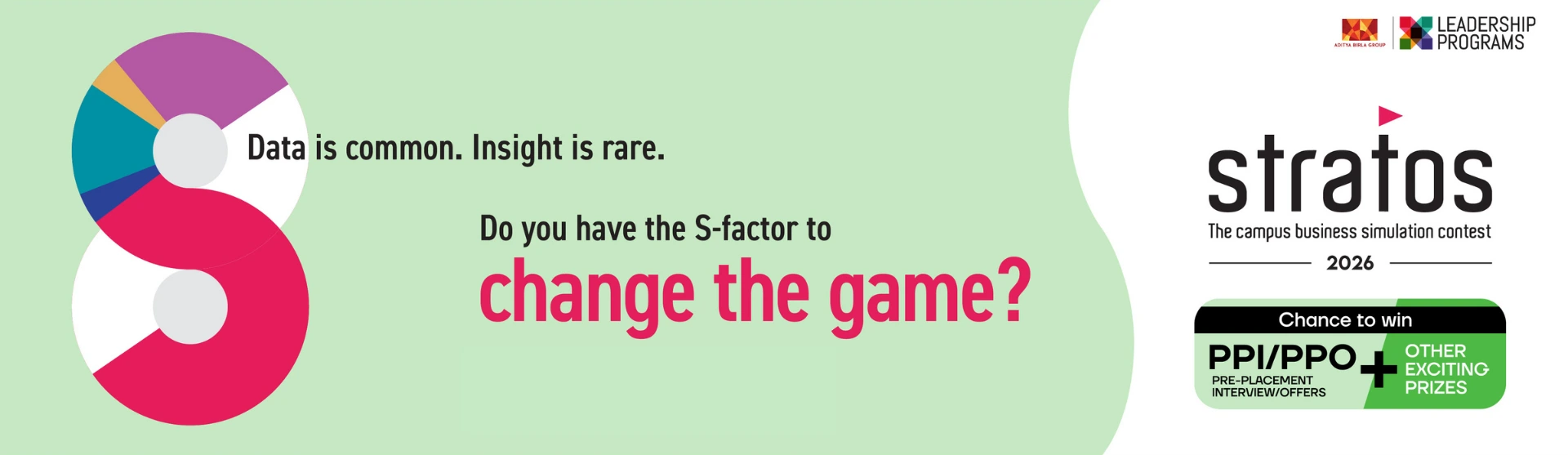
Aditya Birla Group STRATOS 2026 · Simulation First · ₹9 Lakh Rewards
Most competitions start with a quiz. STRATOS starts by handing you a company. Run it well and the case round is yours.
Aditya Birla Group STRATOS 2026 is the group's flagship general management challenge, and its signature is the opening business simulation. Before you write a single slide, you sit in the leadership seat and take live decisions across strategy, marketing, finance and operations, and the simulation score decides who even gets to see the case. Prizes worth ₹9,00,000, iPads, certificates, PPOs and PPIs are on the table. This guide breaks down the funnel, what the simulation actually rewards, how past winners prepared, and the mistakes that quietly end good teams in round one.
Register first, then read the guide
Registration is live on Unstop
STRATOS runs as a single national listing for MBA students from eligible institutes, with teams of three. Registration closing dates have historically been tight, and the simulation round opens soon after the deadline, so the safe play is to register now, lock your team, and treat the reading of the rules as the first hour of your prep.
🎯 Aditya Birla Group STRATOS 2026 · Hosted on Unstop
Register on Unstop
Team size is 3 members. The official Unstop listing is the only source of truth for eligibility, campus list, deadlines and submission formats.
Prizes worth ₹9,00,000 across the podium, along with iPads, certificates and goodies for finalists.
💼
Career outcomes
PPOs and PPIs with Aditya Birla Group. For a conglomerate with 27 companies across 14 sectors, that interview is a door into metals, cement, fashion, financial services or chemicals.
🎮
The signature round
STRATOS opens with a business simulation testing acumen across strategy, marketing, finance and operations. It is the filter, not a formality.
👥
Team and eligibility
Teams of 3 from eligible postgraduate management institutes. Check the campus list on Unstop before you build your team.
📈
Track record
STRATOS has run for several editions and is widely covered as one of the competitions that rebuilt campus hiring around a simulation. Past national winners have come from ISB, IIMs and XLRI.
Context, why STRATOS is built this way
A hiring funnel disguised as a strategy game
Aditya Birla Group is a USD 65 billion conglomerate with businesses spanning Hindalco in metals, UltraTech in cement, Grasim and Aditya Birla Fashion and Retail in textiles and apparel, Birla Carbon and Birla Opus in chemicals and paints, and Aditya Birla Capital in financial services. Hiring for that spread is hard, because a candidate who is brilliant in one function can still be blind to the trade-offs another function lives with every day.
STRATOS was designed to solve exactly that. Instead of asking students to describe how they would run a business, it makes them run one. The simulation puts your team through a compressed set of decisions where a marketing spend affects the cash position, a capacity call affects service levels, and a pricing move affects share and margin at the same time. There is nowhere to hide behind vocabulary.
The practical consequence for you is simple. STRATOS rewards general management instinct more than any single specialisation. If your team is three marketers, you will feel it in the finance decisions. If it is three finance students, you will underinvest in the market. The teams that go deep in this competition are almost always cross-functional by design.
Why this matters to you
The simulation is not a warm-up. It is the round where most of the field goes home, and it is the one round you can genuinely rehearse for. An hour spent understanding how simulation scoring works is worth more than a week of framework revision.
The funnel, reconstructed from recent editions
From the simulation seat to the national finale
1
Round 1
Business simulation round
A timed online simulation that tests business acumen across strategy, marketing, finance and operations. You take a sequence of interlinked decisions for a business and the platform scores the outcomes. Every past edition has opened with this round, and it carries the heaviest elimination load of the competition.
💡 Do a full read of the briefing and the scoring notes before your first decision. Teams routinely lose the round to a misread constraint, not to weak strategy.
2
Round 2
Case submission
Shortlisted teams receive a business case tied to a real ABG context and submit a structured solution, typically a slide deck with a defined page cap. Judges look for a sharp problem definition, a recommendation that survives constraints, and numbers that actually roll up.
💡 Pick one business, one problem, one recommendation. Decks that cover the whole conglomerate read as research, not as advice.
3
Round 3
Regional or semi-final presentations
Teams that clear the submission present to ABG managers and functional leaders, often in a cluster or regional format. The scoring shifts here from what you recommend to how well you defend it when a business head pushes back on your assumptions.
💡 Build an appendix of your three weakest assumptions with a defence ready for each. Panels find them anyway, so it is better if you found them first.
4
Grand Finale
National finale with ABG leadership
The final teams present to senior ABG leadership. This is where the cash prizes, iPads and the PPO and PPI conversations are decided. Past finalists describe the finale as less of a presentation and more of a boardroom conversation, with jury members probing implementation, cost and sequencing.
💡 Prepare a 60-second version of your recommendation. Finale panels often interrupt early, and the team that can restate its answer crisply keeps control of the room.
A note on accuracy
Round names and counts shift between editions
STRATOS has used slightly different stage structures across seasons, and the 2026 edition may add or merge rounds. The funnel above is reconstructed from recent editions and public coverage, and is directionally reliable, but the official Unstop listing is the only authoritative source for dates, formats and eligibility.
Inside the simulation
The four dials you will be judged on
Simulations differ in interface, but the underlying scoring logic in a general management simulation is consistent. You are being watched on how you balance four dials that pull against each other. Knowing them in advance is most of the advantage.
Dial 1
Strategy and positioning
Which segment do you serve, and what do you deliberately not do? Simulations punish teams that chase every segment at once with thin margins and no share.
Dial 2
Marketing and demand
Price, promotion and channel spend move volume, but with a lag. Front-loading spend and cutting it later usually scores worse than a steady, targeted allocation.
Dial 3
Finance and cash
Profit is scored, but so is solvency. Watch working capital and debt. Teams that win the market and run out of cash are a standard simulation casualty.
Dial 4
Operations and capacity
Capacity and inventory decisions are slow to reverse. Under-build and you leave demand unserved, over-build and fixed costs eat the margin you fought for.
One practical habit separates strong simulation teams from the rest. Before each decision round, write down what you expect to happen and why. After the results, compare. Two cycles of that and you have effectively reverse engineered the scoring model while other teams are still guessing.
How to actually win it
Seven things the shortlisted teams do differently
1
Build a cross-functional team on purpose
One person who is comfortable with numbers, one who thinks in markets and customers, one who can structure and present. STRATOS scores across four functions, so a team that leans entirely in one direction is handicapped before it starts.
2
Assign decision ownership before the simulation opens
The clock is the real opponent. Decide in advance who owns pricing, who owns capacity and who owns the final call when the team disagrees. Teams that debate governance during a timed round lose decisions by default.
3
Play a practice simulation before the real one
Any general management simulation will do. What you are building is the reflex of reading a dashboard fast, spotting which variable moved, and adjusting without panic. That reflex transfers completely.
4
Learn the ABG portfolio properly
Know what Hindalco, UltraTech, Grasim, Aditya Birla Fashion and Retail, Birla Opus and Aditya Birla Capital each do, and one live challenge for each. When the case lands, this is the context that lets you start solving on day one instead of day three.
5
Make the case deck a decision document
Lead with the recommendation, then support it. Every slide should either prove the recommendation, size it, or explain how it gets implemented. Cut anything that only shows how much research you did.
6
Size the impact even with imperfect data
Winners consistently show their assumptions and their math. A defensible estimate with a stated basis beats a confident claim with no number behind it, and jurors reward the reasoning even when they disagree with the figure.
7
Rehearse the pushback, not just the pitch
Have a friend play a sceptical business head for twenty minutes. Why this segment, what if capex is halved, what happens in year two, how do you measure it in six months. Those four questions cover most of what a finale panel will ask.
What is on the table
₹9 lakh in rewards, and a conversation with a 14-sector conglomerate
🥇 National Winners
Top of a ₹9,00,000 pool
The national title, cash prize, iPads and certificates, plus a PPO or PPI conversation with Aditya Birla Group.
🥈 Runners-Up
Cash + iPads
Runner-up teams share in the reward pool and receive certificates along with PPO or PPI opportunities.
🎁 Grand Finalists
Goodies & Certificates
Reaching the finale means presenting to ABG leadership. That visibility has historically been worth more than the prize money.
📜 All Eligible Participants
Participation Certificate
A credential you can list, and a simulation experience you can talk about in any placement interview.
An honest ROI read. STRATOS asks for one intense simulation window plus one strong case cycle. Compared with competitions that demand a quiz grind before anything interesting happens, the effort here goes straight into skills that show up in your summers, your finals and your first job.
Stages, timelines, eligible institutes, prizes and FAQs. Read the FAQ section, it usually answers the submission format questions everyone posts later.
A first-person account of preparation, mentorship and how the winning team approached the case. Useful for calibrating how much depth the finale expects.
AceMBA is an independent mentorship platform and is not affiliated with, endorsed by, or officially connected to Aditya Birla Group, its subsidiaries, Unstop, or any entity mentioned in this article. All competition details, including prize amounts, rounds, eligibility and timelines, are compiled from public sources and past editions as of the date of publication, and are subject to change by the organisers without notice. The official Unstop listing for STRATOS 2026 is the sole authoritative source of competition rules. Please verify all details there before registering. This article is for educational and informational purposes only.
Discussion
Share your thoughts, case or interview experiences, or strategy insights.
Comments are read by Mentors and all other students. Be respectful, on-topic, and constructive.